I first met Loris in 2021, during an evening gathering with friends. Back then, it was Richard and him, and we ended up spending the whole evening together. Not long after, we visited Einstein for the first time.
What struck me immediately was the depth of the wine list. It is the kind of list that stays with you long after the evening ends, and the kind that already gives you a reason to return. Since then, we have come back regularly. Not as often as we would like, but often enough to know that no two visits feel the same. Sometimes we choose a bottle ourselves. This time, we followed the pairing.
Loris is one of the very few people I trust completely when it comes to wine. What sets him apart is not only his understanding of the food and his ability to build a pairing with precision, but also the way he reads the person in front of him. He pays attention to what you actually like. That changes everything. The result is never a pairing that feels merely correct; it feels considered, personal, and completely in tune with the table.
The evening opened with EMMANUEL BROCHET N.V. Le Mont Benoît (V20), served alongside the aperitif, snacks, saffron soup, veal tartare, and Balfegó tuna. Brochet farms just 2.5 hectares, all within the single lieu-dit Le Mont Benoît in Villers-aux-Nœuds, just south of Reims. It is a tiny Champagne address built entirely around one site, giving the wine a very clear sense of origin from the outset.
With Norwegian king crab came NEUMEISTER 2015 Stradener Alte Reben Sauvignon Blanc. The wine is sourced from some of Austria’s oldest Sauvignon Blanc vines, planted in 1937, 1951, and 1967 in Straden. These steep sites can only be worked by hand, and that foundation of vine age and place defines the wine as much as the variety itself.
For foie gras, the pairing moved to KOEHLER-RUPRECHT 2018 Kallstadter Saumagen Riesling Auslese trocken. Kallstadter Saumagen is one of Germany’s historic vineyard names, and Koehler-Ruprecht is among the producers most closely associated with it. Within the estate’s dry Riesling range, the Auslese trocken represents one of the most complete expressions of the site.
With red mullet, two Chardonnays were poured side by side: CHÂTEAU DE BÉRU 2019 Chablis Côte aux Prêtres and GANEVAT 2019 Chardonnay La Gravière. The Béru placed Chablis in a low-intervention frame, with native-yeast fermentation and bottling without fining or filtration. The Ganevat, from the Jura, came from old Chardonnay vines rooted in grey Lias marl and iridescent marl, with around 30 months of lees ageing. Together, the two bottles turned the course into a comparison not only of region, but of philosophy.
The duck course was accompanied by DOMAINE JEAN GRIVOT 2014 Nuits-Saint-Georges Charmois and DOMAINE JEAN GRIVOT 2017 Nuits-Saint-Georges Charmois, both served blind. Presented this way, the wines became a direct vintage comparison of the same bottling from the same producer and the same site. Les Charmois, a village-level lieu-dit in Nuits-Saint-Georges with a cooler northeast exposure, has a distinct identity within the appellation, making the contrast between years especially compelling.
The next course moved into Spanish reds with LUIS A. RODRÍGUEZ VÁZQUEZ 2019 A Torna dos Pasas, followed by LÓPEZ DE HEREDIA 2001 Viña Tondonia Reserva, the latter poured blind. Rodríguez’s wine comes from Ribeiro and is built from local varieties including Brancellao, Caiño Longo, Caiño Redondo, and Ferrol, placing it firmly within the language of Galicia rather than any international red-wine model.
Alongside it, Viña Tondonia Reserva 2001 represented an entirely different Spanish tradition. López de Heredia, founded in 1877, remains one of Rioja’s defining historic estates, and the Viña Tondonia vineyard itself was planted in 1913 and 1914 on the right bank of the Ebro. In a single course, the pairing brought together two distinct ideas of Spanish red wine: one shaped by old Galician field blends, the other by Rioja’s long-ageing classical cellar culture.
With Sbrinz came AUGUSTE CLAPE 2018 Saint-Péray. Saint-Péray, just south of Cornas, is a white appellation historically associated with Marsanne, which already places the bottle in a different light from the wines for which Clape is most commonly known. It was a reminder that even producers with an established reputation can reveal another side of themselves through the right context.
The pre-dessert was paired with J.J. PRÜM 2021 Wehlener Sonnenuhr Spätlese. Joh. Jos. Prüm was founded in 1911, and Wehlener Sonnenuhr remains one of the estate’s emblematic Mosel vineyards. The cooler, wetter conditions of the 2021 growing season form an important part of the wine’s background.
The final apricot course came with DAGUENEAU 2019 Les Jardins de Babylone. Produced in Jurançon from Petit Manseng, the wine comes from a vineyard of around three hectares, farmed for low yields and harvested by hand. Even within the wider Dagueneau universe, it stands apart, both geographically and stylistically, from the estate’s Loire identity.
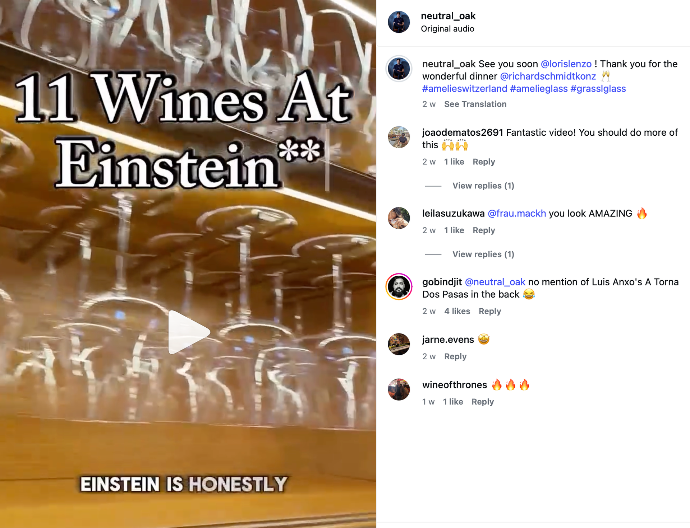
Taken together, the pairing moved from single-site grower Champagne to old-vine Sauvignon Blanc from Straden, dry Riesling from Kallstadter Saumagen, Chardonnay from both Chablis and Jura, a same-wine vintage comparison in Nuits-Saint-Georges, two very different Spanish reds, Saint-Péray from Clape, Mosel Spätlese, and finally Petit Manseng from Jurançon. The line running through the evening was not simply region, but site, vine age, and producer identity.
That is also why I will continue recommending Einstein. It is not a place you fully understand on the first, second, third, or even fourth visit. It reveals itself gradually. Part of that comes from Loris and his remarkable ability to adapt to your style over time. The experience is never static; it evolves with each return.
At the same time, the food is of the highest quality, and that is what allows the entire evening to hold together so naturally. What makes Einstein rare is that the relationship between food and wine does not feel constructed, performative, or driven by trend. It simply works. There is no sense of anything being forced. What comes through instead is the hunger of the team — their appetite to make the experience complete.
So a sincere thank you to the team at Einstein, and to everyone behind an experience I thoroughly enjoyed.