Starting a wine list from scratch can be both a blessing and a curse:
For some it is a new chapter, a clean slate from which a sommelier can completely redesign and remodel the wine program and build a wine list with direction and focus. For others it can represent nothing but colossal challenges: building relationships with wineries, not having wines aged from release and having to navigate the secondary market with the associated risks, ensuring quality and consistency quickly with many references.
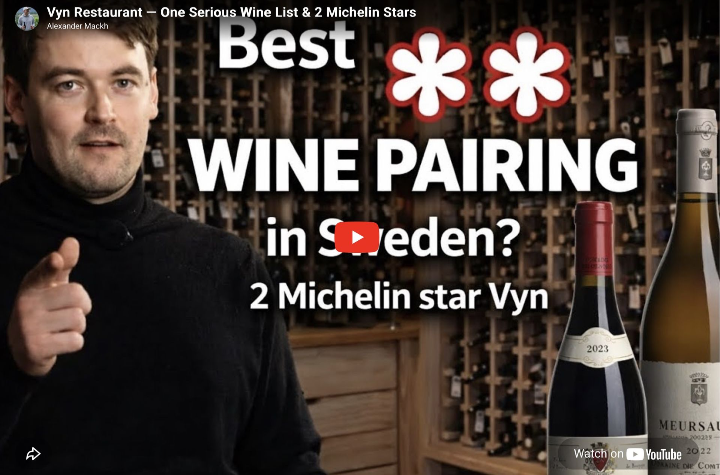
Vyn is a restaurant that knows all about such a challenge. The restaurant itself was a tabula rasa for Head chef Daniel Berlin who opened the restaurant in 2023, following the closure of Daniel Berlin Krog in 2020 after the tragic passing of his wife. In its first year of operation Vyn gained 2 Michelin stars granting it early attention and praise. Although Vyn inherited some wine from the previous restaurant’s cellar, under Joakim Bloomster, Wine Director and Partner, the wine program and list was fundamentally redesigned.
Brothers Thiago and Joao Matos who we have known for years as connoisseurs at the forefront of the wine and gastronomy world currently work at Vyn as head sommelier and head of Creative kitchen respectively.
We were excited to meet with them to discover the magic behind a restaurant that has enchanted so many.
The wine list at Vyn does not try to cover the wine world in a region focused way. Instead, it is built producer first, with appellation taking a secondary role. The focus is clearly on scarcity, quality of agriculture, and the identity of the growers and domaines behind the bottles. It is a list rooted firmly in the Old World, with particular strength in Champagne and Burgundy, and it succeeds in presenting real gems alongside benchmark producers. The overall style is focused and thoughtful, with representative estates from key regions rather than a broad but diluted selection.
If there is a weakness, it is the relative youth of many vintages on offer. This is, however, an understandable limitation for a restaurant that has had to rebuild and reshape its cellar in a short period of time. Sourcing older wines today comes with obvious difficulties, not only in terms of price, but also provenance and condition. Within those constraints, the team has done an admirable job.
Among the producers that stood out most to us on the list were Faure, Lamy-Caillat, Aurélien Lurquin, Gaspard Brochet, Stéphane Bernaudeau, Lorenzo Accomasso, and Clos Rougeard — names that immediately reveal the restaurant’s priorities and speak to the seriousness of the program.
The pairing is developed collaboratively by Joakim and Thiago, and three options are offered. The standard pairing, priced at 240, is European in focus and leans primarily on Germany, France, and Italy. The prestige pairing, at 430, remains largely European but introduces a few surprising diversions, including ale. Finally, the cellar pairing, at 930, offers a more elevated path through the meal with some unicorns in the mix.
We opted for the prestige pairing, which proved to be both intelligent and deeply enjoyable. It began in the lounge with Cédric Bouchard’s Roses de Jeanne “Val Vilaine” R23, served as an aperitif alongside a series of bites. Bouchard remains one of my favourite Champagne producers, and this was a compelling way to begin: energetic, precise, and full of personality. The only regret was the glassware choice, as it was served in the Vigneron 1855, which felt unnecessarily large for the wine.
The first wine at the table was the 2016 Hubacker Riesling Grosses Gewächs from Weingut Keller. I have only limited experience with Rheinhessen, though Keller is of course one of the region’s most famous names. The wine was stern, steely, and serious, pairing beautifully with the fish dishes in a way that felt both classic and refined.
This was followed by the 2022 Meursault from Comtes Lafon, a producer we are particularly fond of. Here the wine hit exactly the right note, with its generosity and richness dovetailing beautifully with the pike perch and cabbage dishes. It was one of those pairings that feels effortless while still being highly effective.
A Hill Farmstead Vera Mae Ale then offered a lighter alternative to wine, bringing liveliness and intrigue to the progression of the meal. It was a clever inclusion: refreshing, characterful, and handled with enough confidence to justify its place in a serious pairing.
The red sequence began with the 2023 Jean-Marc Roulot Beaune-Teurons 1er Cru, a wine with slightly more generous and rustic notes, yet still very clean in profile. It worked well with the game, bringing youthful energy and dynamism without becoming tiring over the course of a long meal.
After this came the 2021 Côte-Rôtie from Domaine Jamet, which was a fantastic and classical match for the wilder game dishes. The pairing itself was excellent, though here again the glassware did not feel entirely ideal. To better preserve the texture and aromatic precision of the wine, I would have preferred a white wine glass.
Dessert was paired with the 1997 Château de Fargues, a wine of depth, sweetness, and resonance that worked particularly well with the acidity in the desserts. To finish, Hill Farmstead Samuel Ale provided a refreshing close to the meal: citrusy, flavourful, and an unexpectedly graceful final note.
Alongside the pairing, I also selected two wines from my own cellar: the 2017 Domaine Hudelot-Noëllat Richebourg and the 2018 Roulot Clos des Bouchères.
The Roulot Clos des Bouchères was served alongside the Lafon and brought an obvious additional layer of complexity and depth, making it especially exciting to drink next to the fish courses. It was a joyful comparison and a reminder of just how expressive great Meursault can be in the right setting.
The Richebourg was first served with the meats alongside the Beaune. It was a stunning Burgundy, possessing the kind of intensity and depth that allows it to stand comfortably beside stronger game flavours. It was an impressive showing from one of Burgundy’s finest winemakers and added considerable gravitas to the latter stages of the meal.
In a world where pairings have at times become overly cerebral — more disruptive and more "interesting" to discuss than to actually experience — it is refreshing to encounter a program that returns to pairings that simply work. Yet that should not be mistaken for simplicity. To execute classical pairings at this level still requires real knowledge, restraint, and skill, and the team at Vyn clearly possesses all three. Nothing here feels odd for the sake of being edgy; everything is done with intelligence and purpose.
With the exception of a few less convincing glassware choices — Where the glass shapes did not suit the wines they were served in — Vyn offers a wine experience that will satisfy any wine lover in the know. From the list itself to the construction of the pairing, this is a program built on sound judgement and genuine understanding. For those who appreciate marriages that are classics for a reason, a meal at Vyn will be truly rewarding.